
Front end and Suspension
What Everyone Should Know About Wheel Alignment

On this vehicle, the front wheels are not aligned to the rear thrust line. This can happen from normal wear and stress, whether your vehicle has adjustable or non-adjustable rear suspension.
To steer straight ahead, you would have to steer the front wheels slightly to the right.
A common result would be that the vehicle would "dog track" and possibly "pull" to the side.
Of course, the angles are exaggerated so you can more easily see the condition. But it takes only a small misalignment to create problems.
Why Four Wheel Alignment?
Reduced Tire Wear
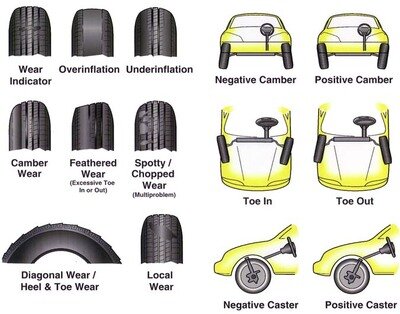
Improper alignment is a major cause of premature tire wear. Over the years, a properly aligned vehicle can add thousands of miles to tire life.
Better Gas Mileage
Gas mileage increases as rolling resistance decreases. Total alignment sets all four wheels parallel which, along with proper inflation, minimizes rolling resistance.
Improved Handling
Does your car pull to one side? Does the steering wheel vibrate? Do you constantly have to move the steering wheel to keep your car traveling straight ahead? Many handling problems can be corrected by total alignment.
Safer Driving
A suspension system inspection is part of our alignment procedure. This allows us to spot worn parts before they cause costly problems.
Here's what we do:
For vehicles with non-adjustable rear suspensions
- Angle readings are measured at all four wheels.
- The steering wheel is centered.
- Front wheels are referenced to rear thrust line and set to specifications.
Result: All four wheels are parallel and the steering wheel is centered.
For vehicles with adjustable rear suspensions
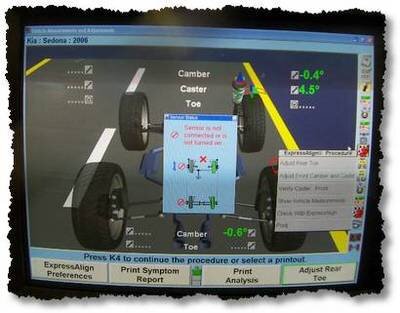
- Angle readings are measured at all four wheels.
- Rear wheels are set to specification.
- Steering wheel is centered.
- Front wheels are referenced to the rear thrust line.
Result: all four wheels are positioned straight ahead and parallel.
Important Questions About Wheel Alignment
Q. How important is wheel alignment?
A. A car with toe alignment just 0.34 degrees out of specification can drag its tires sideways for more than 68 miles per year.
Q. What are the symptoms of misalignment?
A.
- Excessive or uneven tire wear
- Vehicle pulls left or right
- Steering wheel vibration
- Loose or wandering steering
- Steering wheel not centered
Q. How often should alignment be checked?
A. Every 10,000 miles or at least once per year.
Need Alignment Service?
If we can straighten you out give us a call
Call (248) 478-838224175 Industrial Park Dr., Farmington Hills, MI 48335
